

Vindral Composer R2 2026 is now available. The release ships a major V-Track Roulette upgrade for live casino studios, makes Extended Monitoring standard in every Composer licence, sharpens a long list of broadcast features for live production, and adds self-hosted LLM generation that runs on the operator’s own hardware. The same build is in production at SVT as part of their NEO software-defined setup.
V-Track Roulette 2.0: animated overlays for live casino
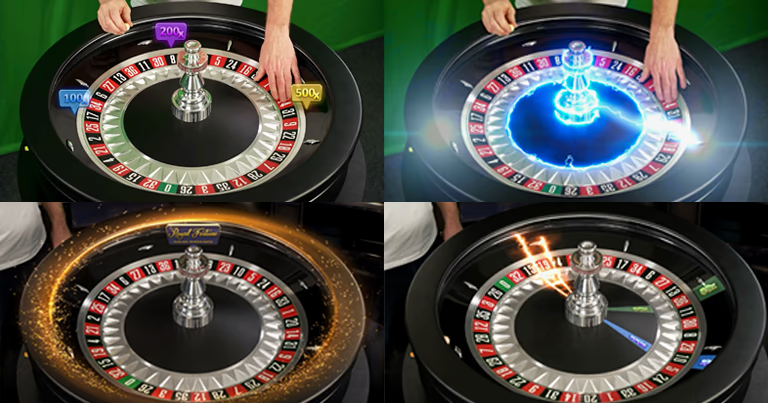
One of the headline features in R2 is a substantial upgrade to V-Track Roulette, the AI-powered tracking and visualisation plug-in used in live casino studio productions. V-Track Roulette 2.0 is rebuilt on the same technology base as V-Track Money Wheel, with a long list of technical improvements under the hood.
The biggest change for game makers is on the wheel itself. V-Track Roulette can now drive animated overlays on the spinning wheel. Earlier versions only allowed static image overlays. With 2.0, any animated content (frame sequences, motion graphics, dynamic branding) can ride along, locked in place by the computer vision tracking.
For studios already running V-Track Roulette, 2.0 opens up a new layer of creative control on the same studio setup.
Extended Monitoring, now in every Composer licence
The biggest change for operations teams: Extended Monitoring is now included in every Composer licence, with no add-on, no separate package, no per-instance pricing. The full feature set is available to every customer from the day they install R2: centralised log management, more than 40 live metrics per instance, extensive server stats, and fully customisable alerts.
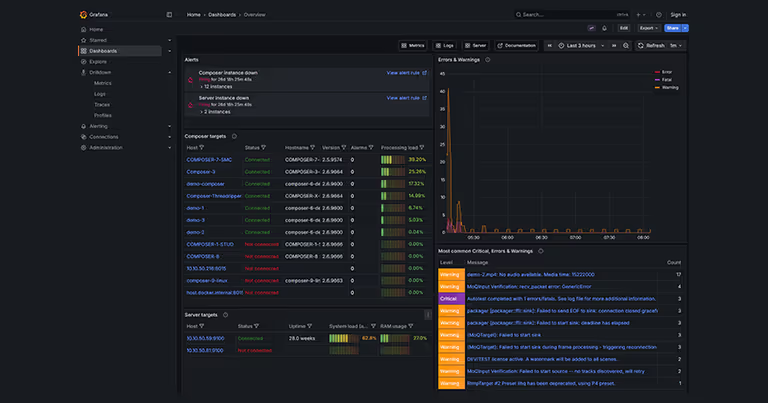
Composer’s underlying telemetry has also been expanded by over 50 new performance and health metrics, covering capture, render, encode and output paths. The Script Engine picks up scheduled play/stop of media, modern ES6 imports, and richer responses when external systems call into Composer. That is useful when game logic or production automation needs to know what actually happened to a request.
Sharpened for broadcast
R2 has the longest broadcast feature list of any Composer release so far.
NDI Tally is now supported on both input and output, so Composer joins the tally chain alongside switchers and cameras. The Decklink integration steps up to 8-channel audio capture and playout, lifting Composer to proper multichannel SDI. Panasonic PTZ cameras can be controlled directly from Composer, with no external middleware.
Signal-loss handling has been rebuilt for live shows that can’t afford dead air. A still-store image can be triggered automatically when an incoming Decklink signal goes to black. Scripts can react to signal loss and signal restoration in real time, so a project can fall back to a slate, switch to a backup feed, or alert an operator within frames rather than seconds.
On the output side, the new RTMP Multi Target lets a single Composer instance deliver several quality levels of the same stream (from 1080p down to 320p) in one operation. Composer can also push directly into the Vindral CDN over Media over QUIC (MoQ), with that target handling local transcoding to multiple qualities in the same step. AV1 is supported on ingest, and incoming RTMP can be decoded on the GPU, freeing CPU headroom for the work that benefits most. Rendering is up to 20% faster across the engine, and a new safety mechanism keeps a project running gracefully when a host briefly runs out of headroom.
For operations that run dozens of Composer instances across a datacenter, the change is meaningful: more outputs per box, fewer boxes per show.
Bring your own LLM, on your own hardware
R2 introduces an LLM input that connects directly to a self-hosted Ollama server. Any open-source language model running on the operator’s machine, GPU node or on-premise server can now generate live text on demand: lower-thirds, tickers, captions, commentator notes, walk-on intros, sponsor reads, news crawls.
Inference stays on the operator’s hardware. No prompts leave the network, there are no per-token fees, and once a model is pulled the system continues to work without internet access. Models can be swapped or pinned per project, and hundreds of open-source options are supported, including current Llama, Qwen, Mistral and Gemma families.
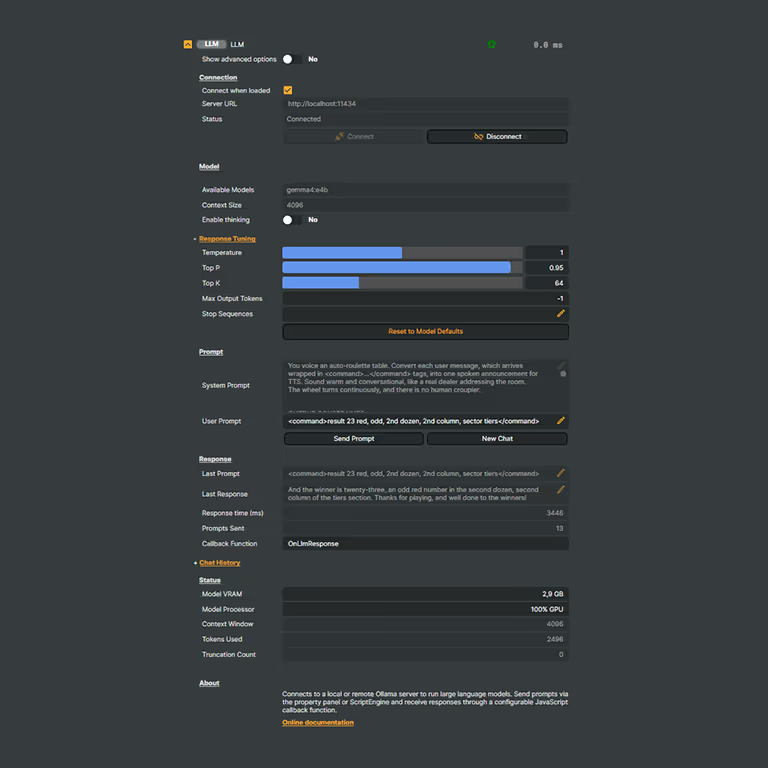
The LLM input also pairs with Composer’s existing AI Speech Generator (powered by the ElevenLabs API) to drive a full AI presenter pipeline: a prompt or game event generates copy, the copy is synthesised into speech, and Composer renders the graphics frame-accurate alongside the audio.
For broadcasters and casino operators that want generative text to stay inside their own perimeter, the language model now lives in the same trust boundary as the rest of the production.
A faster, cleaner studio
Several long-standing UI requests land in this release. Snap-to guidelines, grids and a centre cross make scene layout effortless. Inputs can be organised into folders and shown with thumbnails, which is long overdue for projects with dozens of sources. The interface scales properly from a 13″ laptop to a 4K control-room display, with configurable zoom, scroll and UI scale across the entire program. Menus, message boxes and several panels have been refreshed in passing.
These are quieter changes than the broadcast and AI work, but they are what operators will feel within the first ten minutes of opening Composer.
New creative tools
The GPU operator library continues to grow. R2 adds Motion Detect, Noise Reduction, and Interlace / Deinterlace operators. The biggest addition is a new Exposure & Gamma operator. It is a photographic-style tonal tool with true exposure in stops, a real power-curve gamma, independent Shadows and Highlights controls, and an adaptive Brilliance midtone boost that lifts shadow detail without flattening the rest of the image. An optional linear-light mode delivers photographically correct results when colour accuracy matters.
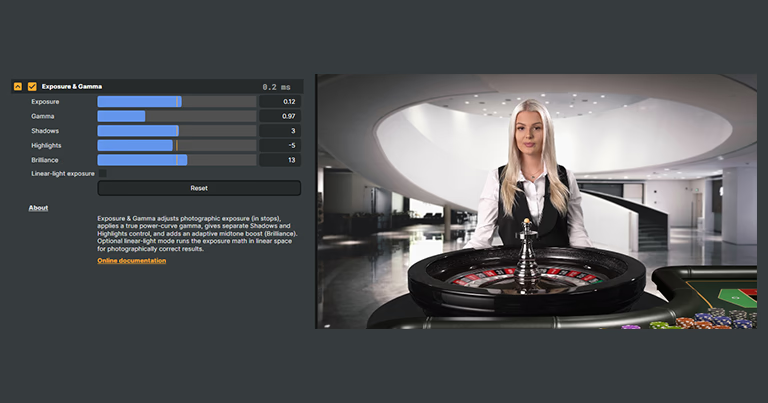
AI vision moves forward at the same pace as the rest of the field: object and image classification now support the latest YOLO26 models.
On audio, R2 adds Seamless Audio File Input and support for .ogg, .opus and .flac. That closes the format gap for archival audio and on-premise TTS workflows.
A new manual for operators and developers
A new Composer manual ships with R2, built and maintained alongside the product so it stays current release after release. It covers every component in its own dedicated section, with modern screenshots throughout and step-by-step tutorials walking through real production workflows.
For operators, it is a clean day-to-day reference and a faster path to productive use. For developers and integrators, it provides complete coverage of the Web API, WebSocket interface, Script Engine and Connectors, with examples that actually run.
Availability
Composer R2 2026 is available for Windows and Linux, in both desktop and headless runtime versions. Existing customers can upgrade through the usual channel; new evaluations are available on request.