

Vindral Composer R3 2026 is now available. Composer is Vindral’s production engine: compositing, audio mixing, graphics and switching in software on standard GPU servers. R3 brings new features for a wide range of use cases, including advanced chroma keying, multi-camera replay and synchronisation of SRT inputs in remote production setups. It also adds a new live captioning operator that runs on your own GPU, eight-channel NDI audio, AES67 audio over IP and new tools for running Composer Runtime unattended.
A keyer you paint
The new Matte Paint Keyer builds its matte from the background colours you paint in the preview, and every colour you mark is keyed out. It is made for backgrounds that one key colour and a tolerance cannot describe, such as an unevenly lit cyclorama, a screen with folds and hot spots, or a set with two different greens. Exclude protects colours the key must never touch, such as skin, hair or a prop in the backdrop’s shade, and wins over anything marked as background.
The HSV Keyer, Composer’s main keyer for single-colour screens, gains edge softness, alpha gamma and edge recovery in its advanced options.
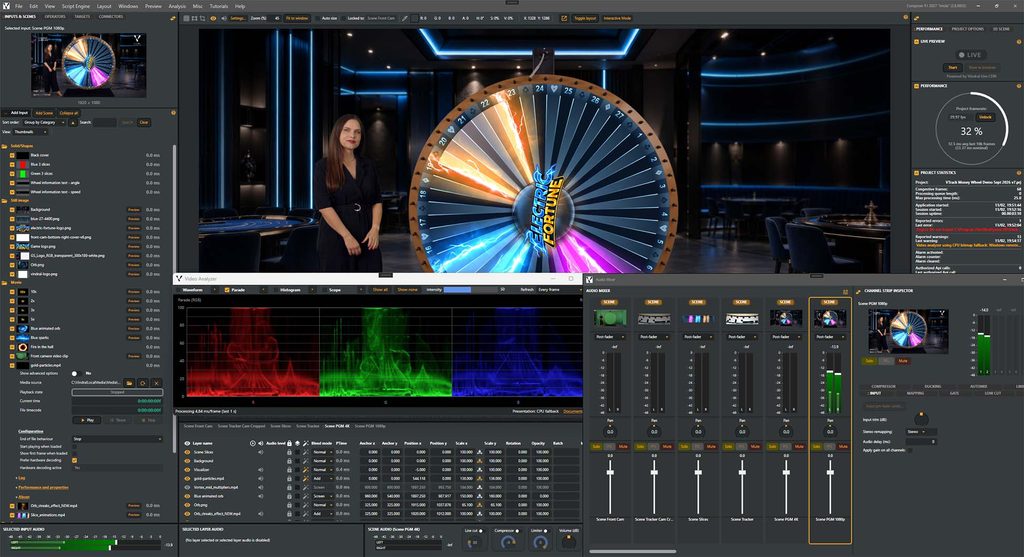
A keyed presenter that matches the background
Background Match measures the background layer and shifts the colour levels of the keyed foreground towards it, channel by channel, so a presenter takes on the tint of a branded background. It matches colour and leaves brightness as it is. The background is re-sampled every 10 seconds by default, and the operator can add a light wrap, a soft spill of background light along the presenter’s edges.
Light Wrap Mask is for multi-branding, where one keyed dealer or presenter feeds many branded scenes. Placed after the keyer, it works out the light wrap’s edge mask once and shares it, and the Background Match in each branded scene reuses it.
Replay from every angle
Composer’s Replay Operator keeps the last few seconds of a layer in memory. R3 adds recording of the whole session to disk. A Replay Recorder Target on each camera scene and on the program writes MXF or MPEG-TS files, and every recorder stamps its frames with the same time-of-day timecode. A Replay Channel plays any recorded angle from any moment while recording continues, forward or backward at up to twice normal speed, including half and quarter speed for slow motion. Changing angle keeps the same moment on screen.
In Composer Desktop, the Replay window is the replay operator’s desk: cue a timecode, step frame by frame, change angle, go live, and mark, name and tag clips in the project’s clip bin. Clips play from the session’s recordings, so they still play after Composer has restarted. Several Replay Channels can play at once, and the HTTP API can drive them from a browser.
Remote cameras in sync and HEVC output
SRT synchronisation keeps the SRT inputs from genlocked cameras frame-aligned with each other. Composer buffers each source and plays it out on its embedded timecode, so the same moment lands on the same frame even when each camera’s link has a different delay. When a link is congested, Hold sync, the default, keeps the alignment exact and lets the group’s latency rise. Low latency keeps the group on schedule instead: a lagging camera holds its last frame and re-locks when its buffer recovers.
On the sending side, the SRT Target can embed SMPTE timecode in the outgoing stream. The SRT Target, MoQ Target and RTMP Target (Multi scaler) can also encode HEVC (H.265) on NVENC. The RTMP Target (Multi scaler) sends HEVC as Enhanced RTMP, so the receiving ingest has to accept it.
Live captions, NDI 6 and AES67
Speech To Text (Nemotron) is a new operator for live captions. It runs NVIDIA’s Nemotron speech model on the GPU in your Composer server and draws captions on the picture as words are spoken, with punctuation and capitalisation. At the default settings, captions appear within about a second. Each word stays as first written, which suits captions going to air, and no audio leaves the machine. The model file is downloaded separately. The Whisper-based Speech To Text operator now recognises 99 languages when a multilingual Whisper model is loaded. The model included with Composer is English-only.
Composer now uses the NDI 6 runtime on Windows and Linux, and the NDI input and NDI Target carry up to eight discrete audio channels. The new AES67 Input and AES67 Target receive and send uncompressed 48 kHz audio over IP.
OCR, new operators and Windows capture
OCR reads printed text and numbers in the picture, such as a scoreboard, a clock or a lower third, and returns them as text through the HTTP API or to a script. Bloom adds soft blur and haze. Unmultiply converts premultiplied fill and key sources to straight alpha. De-Esser tames sibilance in speech and singing, and Stereo Imager controls how wide a sound’s stereo image is.
Window Capture Input brings an application window or a whole display into Composer as a video source, for example a web page behind a login or a desktop application with no streaming output. Windows Audio Capture Input brings in sound from a recording device or from what an output device plays, such as a browser stream or a video call. Both are Windows only.
Target Overview and Runtime tools
The new Target Overview window lists every target in the project and lets the operator sort, filter, start, stop and edit each one in place. The scene preview and the audio mixer can each move into a window of their own, for example on a second screen, and connectors can be organised in groups.
For teams that run Composer Runtime unattended, R3 adds startup, liveness and readiness probes and composer-cli, a command-line tool that controls and monitors a Runtime on Windows and Linux. Runtime lifecycle events can now be followed as a Server-Sent Events feed in every Runtime state, even with no project loaded. API keys can now carry a role: viewer, operator, editor or admin. The platform moves to .NET 10, CUDA 13.3 and Chromium 149.
Before you upgrade
Processing usage metrics are now reported as ratios, so check any alert thresholds built on them and update Composer Monitor manually. Several defaults have also changed. Read the upgrade notes in the release highlights before upgrading a production system.
Availability
Composer R3 2026 is available now, as Composer Desktop for Windows and as the headless Composer Runtime for Windows and Linux. Existing customers can upgrade through the usual channel, and new evaluations are available on request.