

Getting a remote contributor on air often means installing encoder software or sending out equipment. For a commentator working from home, an auctioneer taking remote bids or a user going live inside a platform, that setup can take more effort than the broadcast itself.
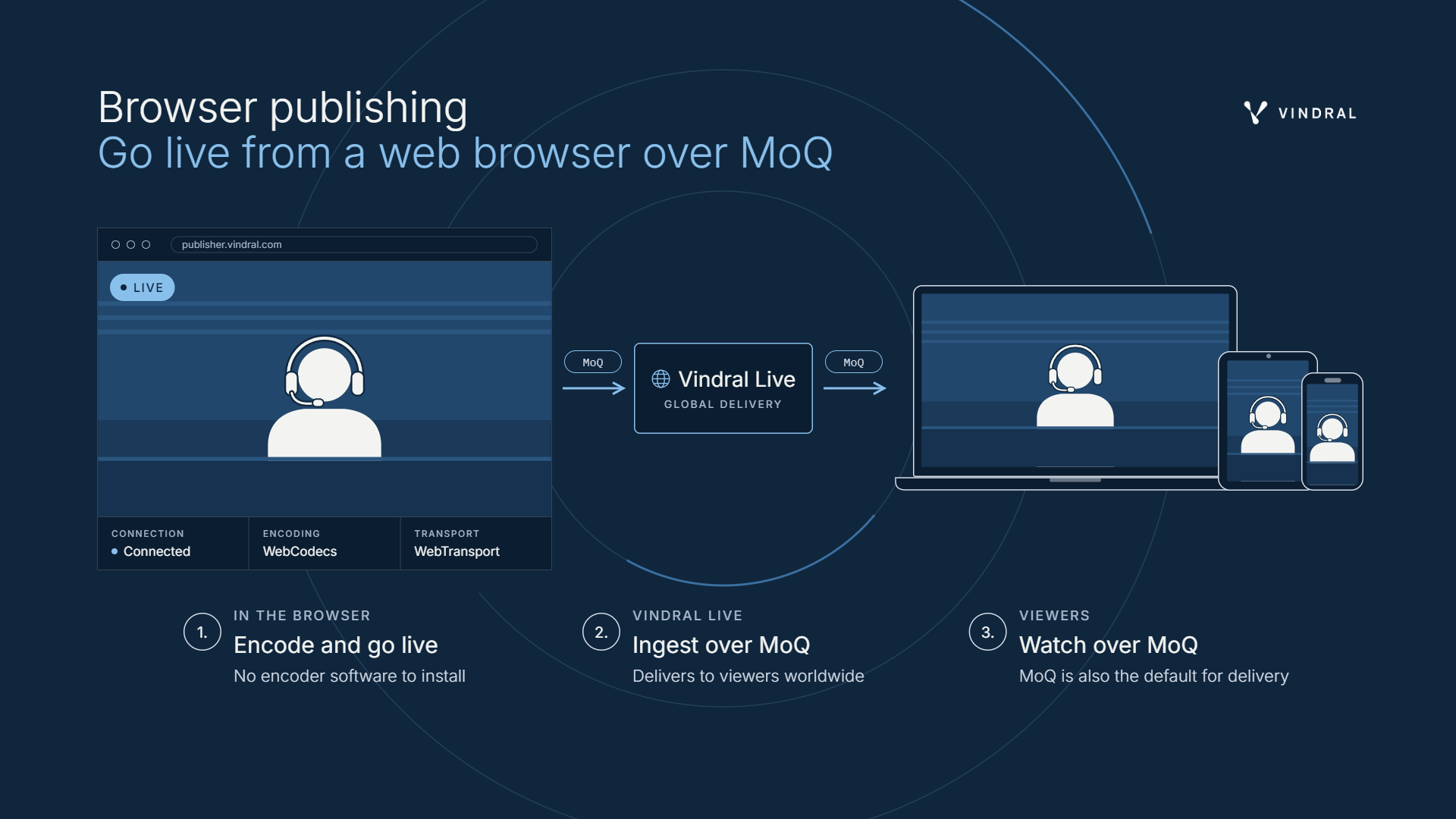
That is why we have added browser publishing to Vindral Live. A laptop with a supported browser can send live audio and video to Vindral Live over Media over QUIC (MoQ), the protocol Vindral Live also uses by default to deliver video to viewers.
The hosted MoQ Publisher is a browser interface where authorized users publish to Vindral Live without building anything. It also shows what the browser supports, along with connection and encoding statistics, which helps when you validate a setup or look into a publishing problem.
The Publisher SDK, available on npm as @vindral/publisher, adds publishing to your own web application. It encodes audio and video in the browser, sends the stream over MoQ and reconnects automatically after an interrupted connection. Your application controls the user experience, and your own backend decides who can publish to which channel through signed JWTs. The SDK can also start encoding before it connects, so a configuration the browser cannot encode is reported before the broadcast begins.
The practical value is straightforward. Commentators and remote guests can join a production from their own laptops, and auctioneers can broadcast to remote bidders from a browser-based auction platform. Platforms can let their own users go live from inside their app, and the stream gets the same delivery as any other Vindral Live stream.
Publishing requires no encoder software on the contributor’s machine and no equipment shipped to them. It uses WebCodecs to encode in the browser and WebTransport to send, with WebSocket as a fallback transport. Google Chrome is the recommended browser. The getting-started guide shows how to install the SDK and authorize a publisher.
For new browser-based integrations, the Publisher SDK replaces WebRTC ingest, which is now deprecated. It remains available for existing integrations.